


Looking back at my 2024 predictions, several materialized faster than anticipated. Generative AI transformed from a buzzword into a tangible threat, with 42% of scams now being AI driven. First-party fraud evolved from a growing concern into a primary challenge. Deepfake attacks during onboarding shifted from theoretical risk to operational reality.
Yet, the same technology driving these threats is now helping risk teams transform their operations and build better defenses. We’ve proven our AI-powered models can see through the user's device and behavior to catch early warning signals of deepfakes and bots before they cause harm.
In 2024, a tier 1 bank discovered that Sonar could have prevented nearly 42% of wire fraud by predicting which wires were being sent to a crypto exchange for a social engineering scam.
This is the turning point. 2025 became the year we fought back.
Let's dive in.
1. Scams become the defining 2025 fraud compliance prediction for risk teams
In 2024, we predicted a regulatory clampdown on scams as losses continued to mount. That prediction proved accurate, but as is often the case in financial services, the response has introduced its own new challenges. While major banks began refunding Authorized Push Payment (APP) scam victims, we've seen an uptick in first-party fraud, where bad actors attempt to exploit chargeback and reimbursement systems under the guise of legitimate claims.
The problem? Reimbursing victims treats the symptom, not the disease. This was my core message when I spoke at the UK’s house of lords, and it’s something we see in the data today.
We'll see this challenge reach critical mass:
- AI-generated scam content will become increasingly sophisticated
- Social engineering attacks will leverage deepfake technology for voice and video
- Scams that start in social media, then move to crypto and banking exploit the gaps between companies, networks and industries.
- First-party fraud will continue its explosive growth
The intersection of these trends creates a perfect storm. Financial institutions can't simply write off these losses, the numbers are too large. They can't just add friction, the competition is too fierce. They need a new approach entirely.
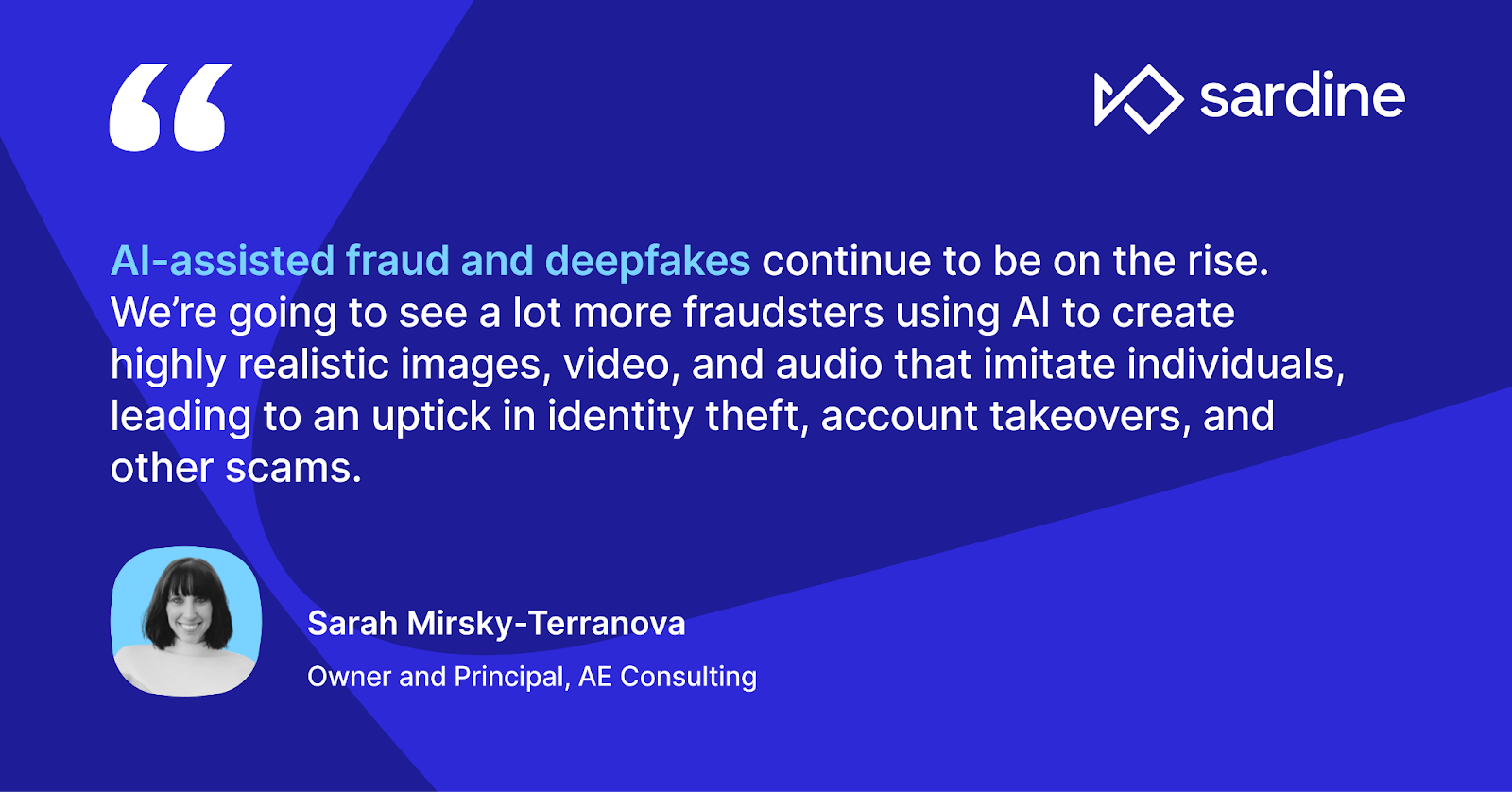
What we see our strongest customers doing is doubling down on ML/AI and training custom models to pick up on unique risk flags. They're also participating in cross-industry consortiums to close up key data gaps. And they're making heavy investments into AI to beef up their risk operations.
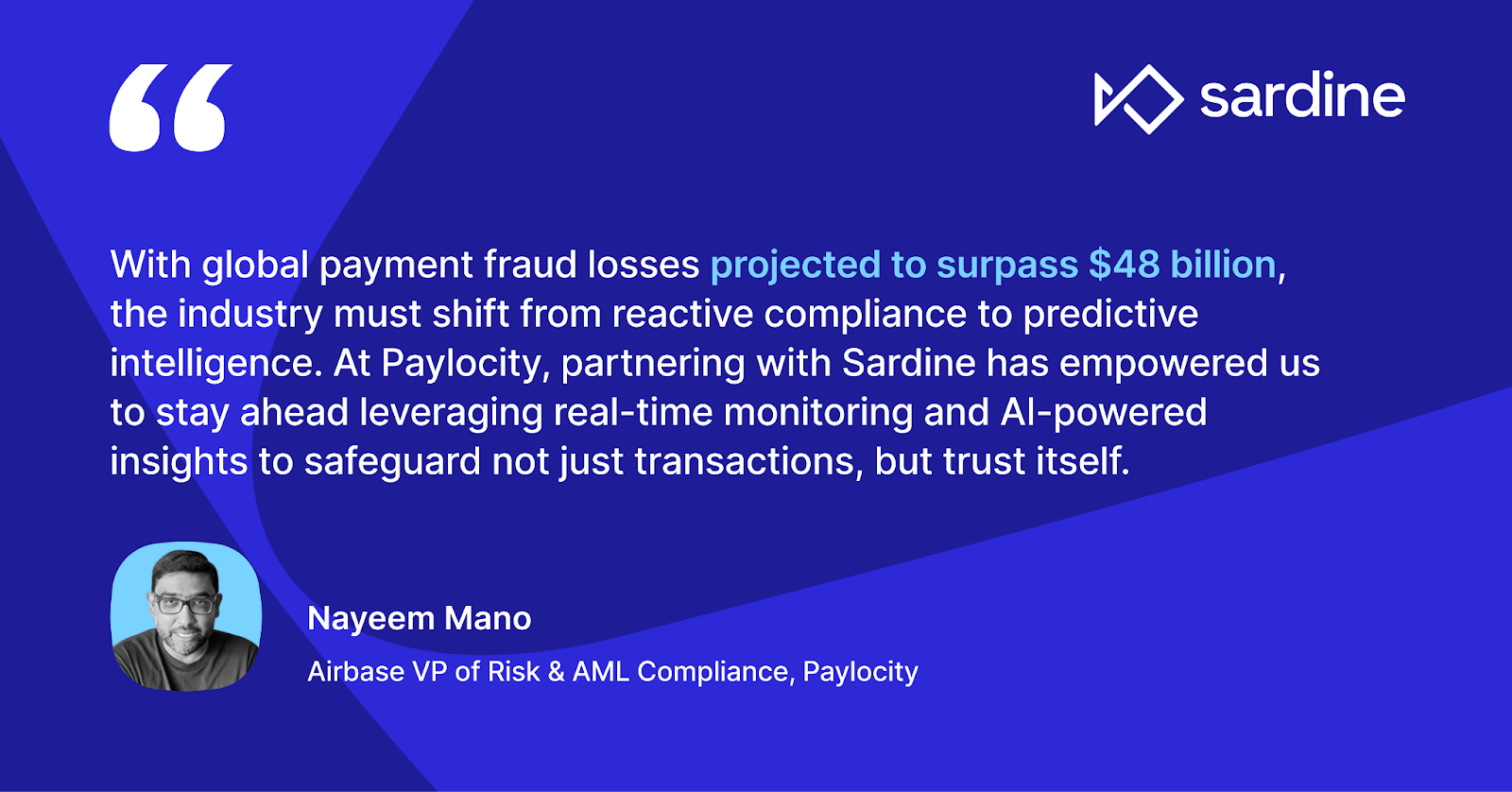
Nayeem Mano, VP of Risk & AML Compliance at Paylocity, echoes this shift:
2. AI agents for risk teams transform fraud and compliance operations
The rise of AI agents is perhaps the most transformative trend in fraud and compliance today. As alerts and SAR filings continue to skyrocket with no sign of stopping, up 800% in just the past few years, risk leaders have come to terms with the fact that you can’t hire your way out of an 8X increase in monthly alerts.
Instead, we’re seeing an increased adoption in AI agents and copilots to help their teams handle the load. These are intelligent systems that manage routine tasks, process massive datasets in seconds, and escalate complex cases when human judgment is required.
Today, Sardine customers are using AI agents to:
- Review sanctions alerts
- Manage dispute resolution
- Review customer onboarding documents
- Pre-screen transaction monitoring alerts
- Assist in SAR narrative creation and evidence collection
- Conduct initial investigations to save time
- Improve capture rates through improved pattern recognition
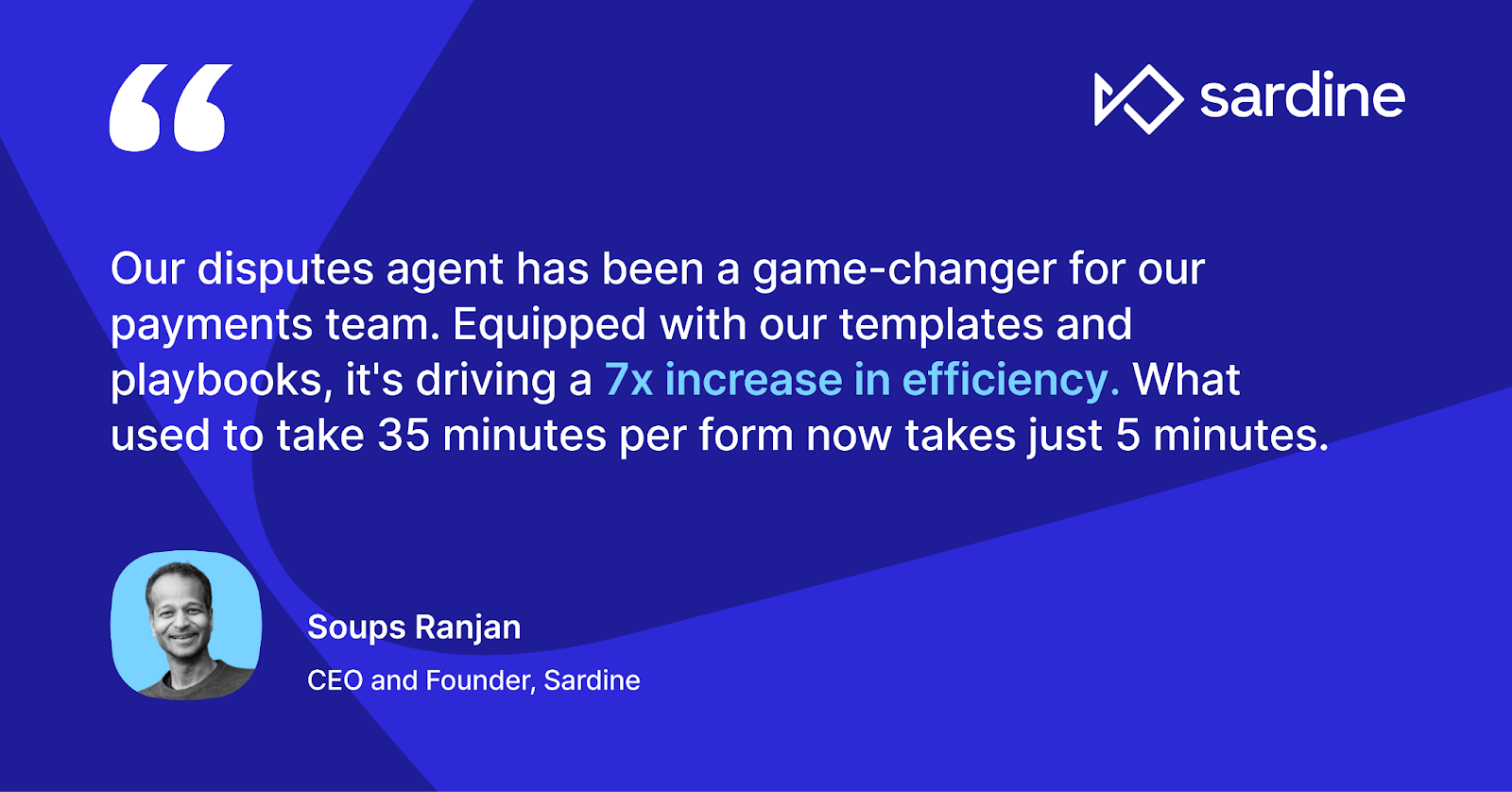
For instance, we’ve been using our dispute resolution agent as a support for our payments team. We equipped it with templates for all the major processors and our team’s playbook for winning disputes, and now the agent speeds up our process significantly. It selects the right template based on processor and dispute type, assembles evidence including device data for Compelling Evidence 3.0 when required, and submits it directly to card schemes like Visa and MasterCard once our Payment Ops Manager gives it the thumbs up.
Jas Randhawa at StrategyBrix also notes that AI Audits are a huge area of opportunity: “AI-driven systems will be capable of analyzing vast amounts of documents and transaction data, identifying complex patterns, and detecting anomalies with remarkable precision. LLMs will excel at processing and interpreting unstructured text, enabling auditors to quickly sift through regulatory documents, internal policies, and customer communications.”
This is what’s making the potential of AI copilots so exciting for risk leaders, and we expect to see a lot more of it in.
3. Cross-sector data sharing reaches critical mass for financial crime prevention
This past year, we saw countless LinkedIn posts with screenshots from Telegram groups and other forums where fraudsters are actively collaborating. The message was clear: if fraudsters don’t operate in silos, neither can we.
While cross-industry data sharing has already proven its value within specific sectors, this year the risk industry really stepped it up. Our Sonar consortium saw unprecedented growth as traditional players partnered with startups to plug critical data gaps. For instance, one tier 1 bank discovered that Sonar could have prevented nearly 42% of wire fraud by identifying wires being sent to crypto exchanges as part of social engineering scams.
Beyond Sardine, we also saw dozens of niche consortiums spring up, such as partnerships like those between Meta, Match, Coinbase, and other tech companies that made headlines for teaming up to tackle online fraud and crypto scams with shared intelligence.
We expect data sharing to expand dramatically:
- Cross-industry consortiums that allow for data sharing across financial services as well as telcos & social media companies will form to combat common threats
- Real-time threat intelligence sharing will become standard
- Regulatory frameworks will evolve to encourage responsible data sharing
- Privacy-preserving technologies will enable broader collaboration
The math is simple because more data means better models. Better models mean fewer losses. The organizations participating in these networks will have a significant advantage over those not.
4. Fraud model validation becomes a regulatory focus for AI-driven risk teams
Another emerging trend that deserves every compliance leader’s attention is the increasing regulatory scrutiny around fraud model validation. Recent years have seen several high-profile banks, fintechs, and crypto exchanges falter, leaving customers in the lurch and forcing regulators to step in. The question regulators are now asking is simple: are your risk controls effective and working as intended?
The challenge, however, is that “model validation” means different things to different people, making it a moving target for financial institutions and fintechs.
Our general counsel, Christine Poulon, notes:
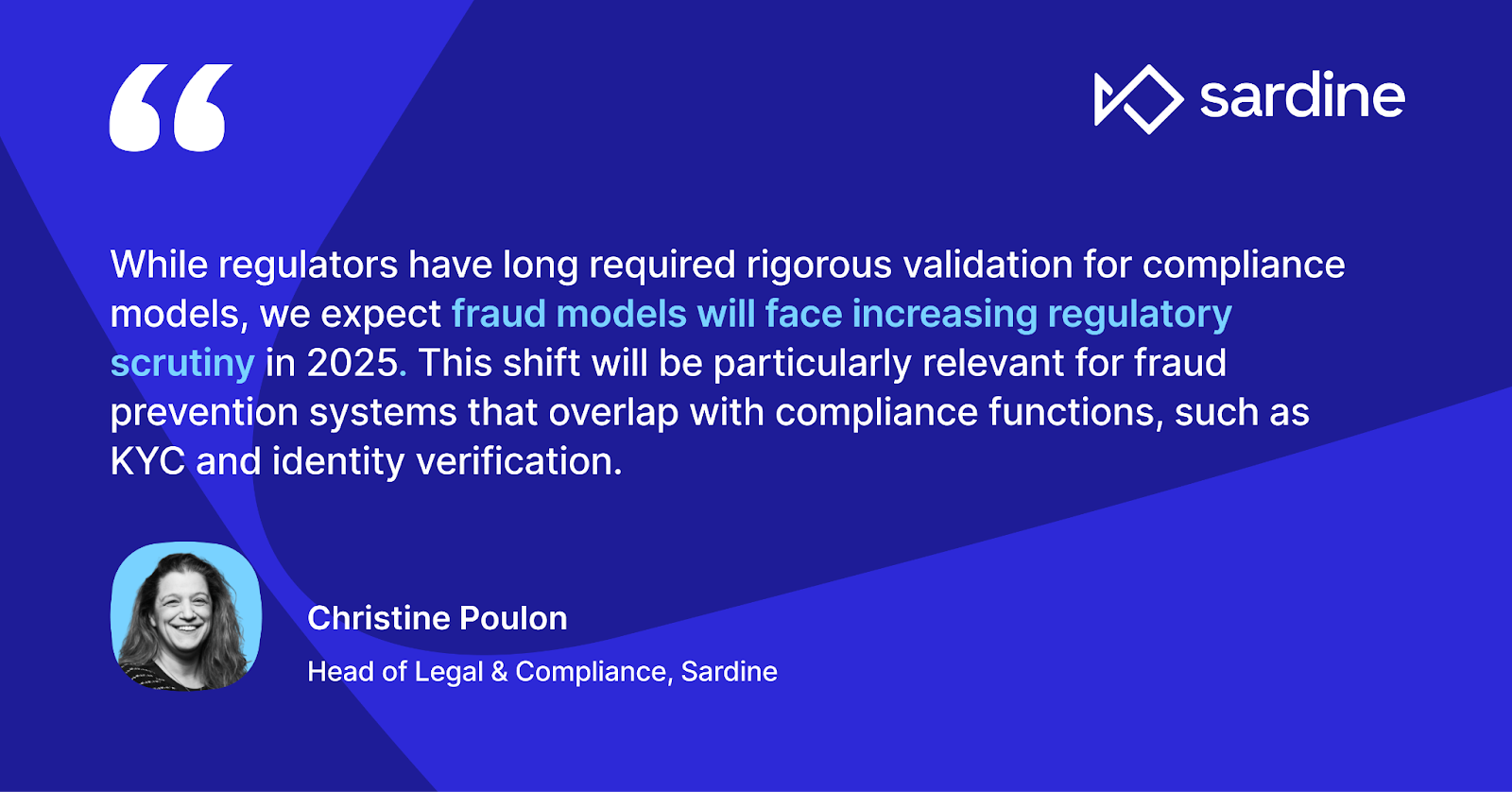
Regulators are asking pointed questions in three key areas:
- System effectiveness. Are your models doing what they’re supposed to do, and are the results measurable?
- Custom configuration. Are your systems tailored to your use case, or are you relying on “out-of-the-box” rules from providers that may not align with your risk profile?
- Model transparency. Can you explain how your machine learning models work, and are they combatting the “black box” reputation some ML/AI systems often carry?
Moving forward, expect:
- Stricter requirements for model explainability
- Regular validation of ML and AI system effectiveness, with an emphasis on stress testing and risk assessments
- Greater scrutiny of "out-of-the-box" solutions, requiring firms to demonstrate how they tailor vendor models to their specific risk environments
- Mandatory documentation of model decision-making
- Increased validation requirements on traditional rule-based engines
As someone who has been deep in machine learning for over a decade, I know that ensuring our systems work as intended and can be measured, explained, and improved, is critical as they become more autonomous. Explainable models are models we can evaluate. And if you can evaluate it, you can improve it. This was a major focus for us in 2025.
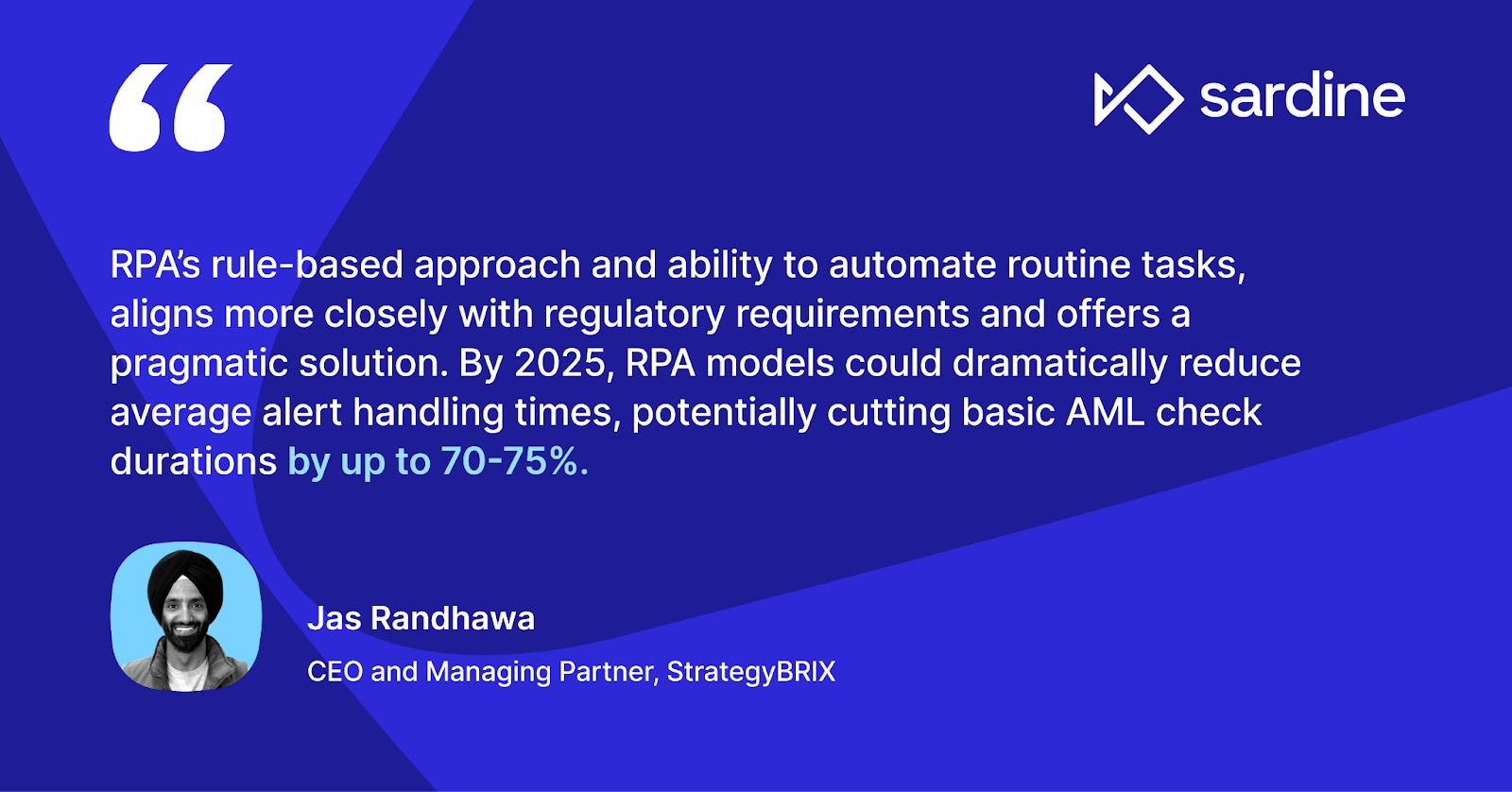
One counterintuitive insight from Jas Randhawa is that this regulatory focus could create an ideal environment for robotic process automation (RPA). While AI and LLMs are advancing rapidly, he believes their black box nature and unexplainable decisions could slow widespread adoption in AML compliance. Instead, regulators may favor RPA’s rule-based approach for automating routine compliance tasks, as it aligns more closely with regulatory expectations.
5. FRAML convergence cuts manual investigations and strengthens fraud prevention
Fraud and compliance teams continue to become more connected than ever, and for good reason. Systems that can link possible first-party fraud, like mule activity, to ongoing investigations or criminal networks in real-time not only prevents fraud, but also ensure a complete audit trail is maintained for compliance purposes.
Critics were vocal in 2024 about why FrAML will never work. They insisted these teams and functions should remain separate. But regardless of where you stand on that debate, one fact is clear: the value of collaboration and data sharing between fraud and compliance is undeniable (and should be non-negotiable).
Sharing risk signals and tools like ML models, network graphs, and even rules engines doesn’t just cut costs by eliminating duplicate spending, it also closes critical data gaps that fraudsters are quick to exploit.
We'll see:
- Models that learn from both fraud and compliance signals in real-time (not just shared data, but shared intelligence)
- Platforms that handle the velocity of fraud AND the complexity of compliance without making you pick one
- A consolidation of risk management tools around a small handful of strategic providers
This convergence is organizational and technological. We are increasingly seeing many banks, both Tier1 and regionals, realize that they get operational efficiency gains by merging fraud and financial crime teams under one leader. The same AI that helps detect complex fraud patterns can identify potential money laundering activity. The data that flags unusual customer behavior can surface compliance risks. A single, unified view of data that is default real-time is ultra powerful.
If you’re interested in learning more about how fraud and compliance teams can collaborate more closely, read this report we put together with our friends at Fintrail.
6. Fraud prevention platform consolidation begins across risk and compliance
The fraud prevention and compliance space has been fragmented, with hundreds of vendors offering point solutions. While this has driven innovation, it's also created complexity, integration challenges, and data silos.
We will mark the beginning of significant market consolidation in the space of fraud & fincrime risk similar to what we've seen in cybersecurity with Palo Alto Networks being acquisitive or with Wiz taking the approach of building a platform from the ground up. With Sardine, so far we have taken the approach of building. And we are seeing our competitors follow suit by merging or acquiring other players. Imitation is often the best form of flattery. We are proud that our vision that the fraud/fincrime risk space needs a new platform thought from the ground up, is resonating.
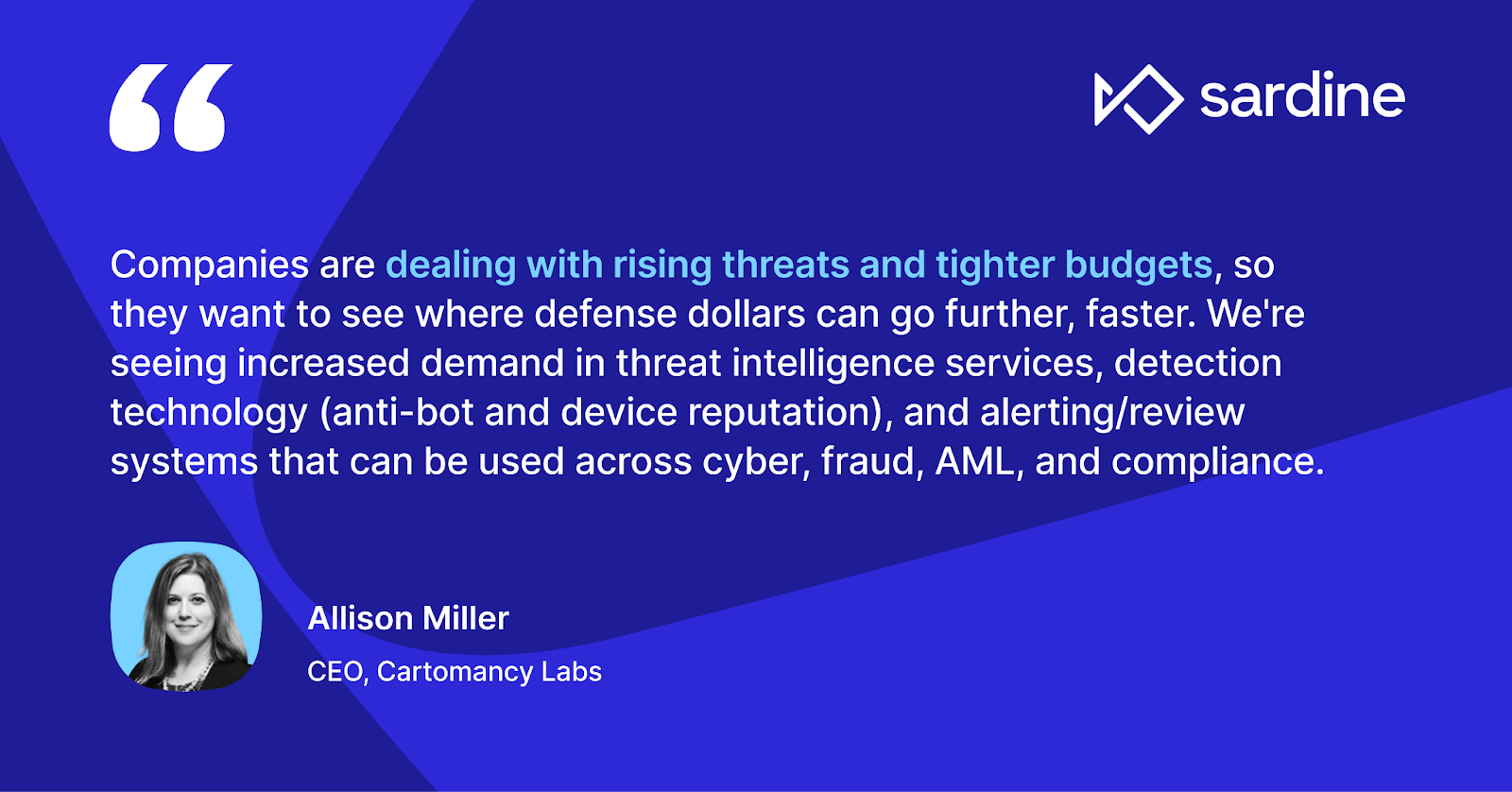
Allison Miller, CEO of Cartomancy Labs, says increased consolidation across cybersecurity and fraud may be on the horizon, as buyers seek solutions that address multiple threats across cyber, fraud, AML, and compliance. With rising threats and tighter budgets, she sees a growing trend of companies looking for technology that stretches their defense dollars further. This will be particularly pronounced in threat intelligence, anti-bot detection, authentication, and alerting systems that can serve multiple use cases.
Organizations are increasingly seeing the value of integrated platforms that combine:
- Proprietary data at scale
- Best-in-class third-party data
- Custom ML models
- Dashboard consolidation and visualization
- AI agents for automation
7. Digital commerce hits its security inflection point for real-time fraud detection
In 2024, bots that were traditionally the domain of “cybersecurity” became a major fraud problem. Just as the finance world has brought fraud and compliance closer, I expect we will see e-commerce, marketplaces, and platforms bring cybersecurity and fraud closer together.
Digital commerce has been fundamentally rewriting its security playbook:
- Bot detection and fraud prevention converge into unified defense systems
- Cross-platform data sharing between marketplaces, payment providers, and banks
- Traditional businesses adopt platform-level fraud prevention
The reality is stark when you can't separate payment fraud from platform abuse anymore. When a bot attack today becomes account takeover tomorrow and payment fraud next week, your defense needs to be equally integrated.
The year ahead
The financial crime landscape has fundamentally shifted. The volume, sophistication, and speed of attacks have outpaced traditional approaches. But new tools have emerged to meet these challenges head on.
The future belongs to risk teams that combine massive data sets, cross-industry intelligence, lightning-fast decisioning capabilities, and AI agents that augment the humans in the loop. We're already seeing clients "go full platform" as they recognize the compound advantage of this integrated approach.
At Sardine, our mission remains constant: to solve financial crime and unlock commerce. We'll continue to lead this evolution, delivering the data, AI, and tools needed to stay ahead of increasingly sophisticated threats. The challenge is enormous, but so is the opportunity. Together, we can build a financial system that's both more accessible and more secure.
Interested in learning more about how Sardine can help you prepare for these challenges? Let's discuss how we can help solve your specific needs.
Special thanks to the Fraud Squad
This year, I reached out to some of the sharpest minds in fraud, compliance, and risk to get their perspectives on what’s happening - and what’s coming next. It’s always a privilege to learn from people who live and breathe this work every day.
A special thanks to:
- Simon Taylor, our Head of Content & Strategy @ Sardine / Author of Fintech Brainfood
- Matt Vega, our Chief of Staff @ Sardine
- Christine Poulon, our General Counsel @ Sardine
- Nayeem Mano, Airbase VP, Risk & AML Compliance @ Paylocity
- Sarah Mirsky-Terranova, Owner & Principal @ AE Consulting
- Allison Miller, CEO @ Cartomancy Labs
- Jas Randhawa, CEO & Managing Partner @ StrategyBRIX
- Karisse Hendrick, Host of Fraudology
- Andrew Austin, our Head of Fraud @ Sardine
Your insights helped shape these predictions, and your work continues to push the entire industry forward. Appreciate you all.
For more insights like this, follow me on LinkedIn and subscribe to our blog.
FAQs about 2025 fraud compliance predictions for risk leaders
What are the most important fraud compliance predictions for risk leaders?
The seven predictions that matter most are scam prevention, AI agents for risk teams, cross-sector data sharing, fraud model validation, FRAML convergence, vendor consolidation, and stronger fraud controls for digital commerce. Together, they point toward a more real-time, data-driven approach to financial crime prevention. The organizations that move on these now will have a meaningful advantage over those that wait.
Why are scams such a major fraud compliance priority?
Losses are too large to write off and too politically visible to ignore. Social engineering is getting more sophisticated, AI-generated scam content is more convincing, and reimbursement expectations are shifting more liability directly onto financial institutions. Refunding victims treats the symptom. Risk teams need scam prevention controls that detect coercion, suspicious payment behavior, mule activity, and AI-generated scam patterns before funds leave the institution.
How will AI agents change fraud and compliance operations?
SAR filings and transaction monitoring alerts are up 800% over the past few years. You can't hire your way out of that. AI agents handle the repeatable work: clearing false positives, reviewing onboarding documents, pre-screening alerts, drafting SAR narratives, and routing complex cases to the analysts who actually need to see them. At Sardine, agents are deployed across six queues today, with every action logged for model validation in line with SR 11-7 model risk management requirements. The result is investigators spending their time on judgment calls, not paperwork.
What is FRAML convergence and why does it matter now?
FRAML convergence is the closer integration of fraud and anti-money laundering teams, data, systems, and workflows. It matters because fraud signals reveal money laundering risk and compliance signals surface fraud networks. Keeping these functions completely separate means running duplicate tooling, missing connections across shared data, and leaving gaps that fraudsters are fast to exploit. A more connected operating model improves investigations, reduces redundant work, and strengthens financial crime prevention across the board.
How does cross-sector data sharing actually work, and what does it produce?
FinCEN's 314(b) provision gives US financial institutions a legal framework and safe harbor to share information on suspected money laundering and terrorist financing across institutions. Sardine's Sonar consortium operationalizes that in real time. Member institutions share derived risk signals across banks, fintechs, payment processors, and crypto platforms. This means a mule account flagged at one institution surfaces at another before funds move. More data means better models. Better models mean fewer losses.