


When Sardine launched in 2021, we were excited to announce that Sardine launched out of stealth to be the first Fraud prevention as a Service (FaaS) solution, built from the ground up for all digital institutions like cryptocurrency and neobank. Our mission continues, and is just as important today, as when we launched. We are designed to help fintech of all sizes, from the very early stage of product launch to larger enterprise companies, detect all types of financial crimes, from identity fraud at account opening through to payment fraud at account funding. We were built so development teams of all sizes could incorporate it into their existing tech stack and be up and running in less than a day. With Sardine, a fraudster can swim but never hide.
What this article covers
- Fraud prevention as a service was built for a different era of fintech. Legacy e-commerce fraud tools were designed around shopping carts and shipping addresses. Sardine was built from the ground up for digital-first businesses where the entire customer journey happens on a device.
- Device intelligence and behavioral biometrics are the foundation. How a user types, taps, scrolls, and moves their mouse reveals things that stolen identities and manipulated devices cannot hide. Fraudsters always have a tell.
- Fraud threatens fintechs at every stage. It can delay a launch by six months, kill early traction, or force friction onto good customers that takes years to remove. Getting fraud right from day one is not optional.
- A single platform beats a stack of point solutions. Combining device intelligence, behavioral biometrics, identity data, card and ACH fraud protection, account takeover prevention, and transaction monitoring in one integration is what makes it possible to move fast without building a manual operations team to compensate.
- The Sonar network makes every customer stronger. When one institution blocks a fraudulent device, the entire network benefits. Shared intelligence across banks, fintechs, and merchants is what closes the gaps that point solutions leave open.
See how Sardine’s fraud prevention platform works today. Request a demo.
Why Sardine: Fintech fraud prevention needed a new approach
Plaid, Synapse, Marqeta, and other Banking-as-a-Service platforms lead a generational shift towards better financial services, making financial products more accessible than ever. As a16Z put it, every company will be a FinTech company, but only if fraud doesn’t kill them first!
Anti-fraud solutions were built for e-commerce platforms in the last decade, relying heavily on catching fraudsters through shopping cart analytics or shipping addresses. However, with the rise in cryptocurrencies and neobanks, these previous solutions cannot adapt to new digital businesses, leading to poor fraud detection, high decline rates, and high false-positives.
When we launched, Statista found that there were close to 20,000 fintech startups globally. That number has since grown past 30,000 and our mission to help these companies and next-gen fintech scale and grow with zero fraud has only grown with it.
The “FraudSquad” at Sardine
To achieve this goal, we’ve assembled an all-star team of fraud fighters from Coinbase, Revolut, Bolt, Uber, and PayPal. Our founding team has deep roots in the industries where fraud is the most complex. Cryptocurrencies, e-commerce, ride-sharing, and cross-border banking have all shaped how we think about the problem. Collectively, we’ve scaled Coinbase by 1,000x while automating their Fraud and Identity programs, launched Revolut’s US business, fought ghost-riding at Uber, built one-click checkout at Bolt, and built fraud protection for the tens of thousands of merchants on PayPal.
We want to change companies’ perception and help them understand that not taking fraud into account at various stages of their business can hold them back. Fraud can hurt your launch, fraud can prevent you from growing as fast you want and finally, fraud measures if not applied judiciously can hurt your user experience.
Fraud can delay your launch by 6+ months
Our founding team was part of Revolut’s US launch. While the fraud team at the time was very vigilant about opening up access to users who had been on our waitlist for several years, we still saw fraud happening from day 1. We learned early on that today’s fraudsters are much more proactive and cunning, they register years in advance to be ready to strike at launch.
Fraud can completely kill your traction
We’ve seen many fintech entrepreneurs hit amazing traction only to have fraud cause a complete standstill, including one startup whose 5,000 new customer signups/month at launch attracted a Series A term-sheet, which was withdrawn when they had to freeze to deal with fraud.
Fraud can hurt your user experience
As soon as companies have a fraud event, they too often add a ton of friction to onboarding or transaction flows. Then it takes them years to remove that friction. In the meantime, their fraud and risk team manually review fraudulent activities and, by the time they achieve product-market fit and grow like crazy, these companies quickly realize those manual operations teams were not built to-scale.
Here’s how Sardine’s fraud detection platform works
Sardine offers a balanced approach toward fraud vs. friction. Our single fraud detection platform combines millions of data points per customer around browser fingerprinting, mobile device attributes, network traffic, sensor data, intrinsic user behavior, and user identities across credit bureaus, telcos, social, banks and cards to identify bad actors quickly and help fintech customers truly authenticate users. Our technology works transparently in the background without impacting user experience while still being privacy-preserving (see demo video).
We have built the first zero-day fraud prevention technology to catch fraudsters no matter what they do, because we look for intrinsic behavior patterns that are impossible for them to hide.
- We find that 5–10% of fintech and crypto signups nowadays are coming from mobile emulators, remote desktops or mobile device farms, as fraudsters can then get a clean device profile that hasn’t been blacklisted before. Our device intelligence technology detects mobile emulators by identifying the true operating system being used and using sensor data to detect if a phone is moving or stationary.
- We monitor how customers type, tap, scroll or move their mouse in a privacy preserving manner and have found that good customers behave very differently than fraudsters: they never copy/paste their own name or their SSN. Another tell? While fraudster typing speed is fast, the dwell time per key is high indicating the use of old hardware with clunky spring keyboards.

Sardine gets digital businesses authentic customers (not just authenticated) by providing a holistic approach to fraud detection, including:
- Foundational Fraud Score. Sardine delivers machine-learnt fraud scores based on proprietary Device Intelligence technology and user behavior biometrics to comprehensively detect fraudsters on all fronts.
- Enhanced Card / ACH Fraud Protection. Sardine’s AI model utilizes thousands of additional signals to cross-check the identity behind the bank account and credit card against dozens of third-party data providers and partners, from credit bureaus, telcos, email intelligence, social media, card, and bank blacklist providers, to ensure that the user can be trusted.
- KYC and Identity Fraud Protection. To provide a complete picture of a user’s identity, Sardine correlates information from multiple data and intelligence sources, including credit bureaus, email, social media, and phone numbers. Further, Sardine detects usage of stolen identities based on nuances in how fraudsters enter someone else’s information vs. how good customers provide their own information.
- Account Takeover Prevention. Sardine enables companies to detect the most sophisticated account takeovers, from credential stuffing attacks and SIM swaps to SMShing and Vishing. Sardine’s multi-factor orchestration (MFA) makes it easy for companies to offer a frictionless way to enforce any additional authentication.
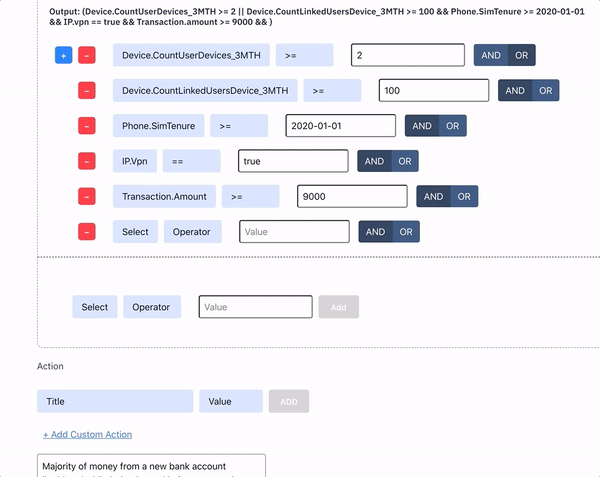
- Continuous Transaction Monitoring. Sardine allows companies to centralize their user workflow and risk management across their Fraud, Compliance, and Trust & Safety teams through 100+ Transaction monitoring rules that cover any fraud, user security, and money laundering typologies, all the while empowering teams to create new approval/rejection rules on the fly and back-test them against historical data to benchmark accuracy.
Early customers and real-world results
At launch, we were proud to work with many early customers including fintech, Crypto companies, and payment processors, including Dharma, Moonpay, Relay Financial, Unifimoney.
- We are helping Moonpay balance fraud and friction when folks buy crypto using a debit/credit card.
- We are helping Dharma provide $25,000 per week of crypto buying power via ACH without worries over fraud.
- We are helping Relay Financial and Unifimoney with all their fraud and identity needs.
“Sardine provides a perfect balance, helping us detect 3x more fraud than before while also reducing friction by 2x. At Moonpay, our mission is to enable access to cryptocurrencies to the next billion customers. To do it, we need really strong defense against a wide variety of fraud attacks, without layering the kind of friction or fear that might turn off customers who are just getting started with crypto.”
Victor Faramond, Co-founder and CTO at Moonpay
The network behind Sardine’s launch
We have been fortunate to work with some of the most helpful investors and advisors, who’ve rolled up sleeves alongside us and helped us build, and bring Sardine to life. We raised a seed round of $4.6M in Aug 2020 that was led by Ross Fubini at XYZ Ventures, with participation from Shelley Zhuang at 11.2 Capital, Anne Dwane at Village Global, Dan Portillo at SweatEquity, and Coinbase Ventures.
We were fortunate to have 25+ angel investors from US and EU who supported us in our seed round including, Adam Nash, former CEO and president of WealthFront; John Lilly, partner at Greylock; Dan Romero, former VP of Coinbase; Linda Xie, Partner, Scalar Capital; Ed Cooper, Head of Crypto at Revolut; Andre’ Mohamed, former Head of Wealth & Trading at Revolut; Cristian Strat, former Head of Trading Platform Engineering at Coinbase; Mircea Pasoi, Engineering Manager at Novi Financial; Ankit Jain, CEO, Infinitus and Former Founding Partner, Google’s Gradient Ventures; Anshu Sharma, CEO, Skyflow Privacy Vault; Ron Atzmon, Active Deputy Chairman at Au10tix; Sean Byrnes, CEO of Outlier.AI and LucidFog; Jeff Weinstein, Product Lead at Stripe; and CEOs and operators of many Silicon Valley companies.
We also created an operational and technical advisory board and are thrilled to announce that Eric Woodward, former President at Early Warning Systems, Dan Westgarth, COO at Deel, Andrei Savu, CEO at Moonsense and Brian Mullins, SVP of Risk at Chime have decided to join us on our journey!
We are thrilled to announce partnerships with some of the most visionary companies in identity and payments space, including Au10tix, Blockset by BRD, Chainalysis, Checkout.com, EmailAge from LexisNexis, Prove, Sentilink, Very Good Security and many others to be announced soon!
Join us on our mission
Our mission is to enable the digital economy to operate at scale without fraud.
We are just getting started, and we can’t do it alone. If you are building a company in crypto, NFTs, fintech or digital subscriptions, please reach out! You can join us on Slack, check us out on Twitter, and subscribe for updates. (We’re also hiring!)
Since its launch in March 2021, Sardine has grown to serve 300+ enterprises across 70 countries, profiled over 2.2 billion devices, raised $145 million including a $70M Series C in February 2025, and expanded the platform far beyond its founding capabilities. You can read the full story of where we are today in our Series C announcement.
Fintech fraud prevention as a service FAQs
What is fraud prevention as a service and why does it matter for fintechs?
Fraud prevention as a service is a platform-based approach that gives digital businesses access to fraud detection, identity verification, device intelligence, behavioral biometrics, and transaction monitoring through a single integration rather than building or buying separate tools for each function. For fintechs, it matters because fraud appears at every stage of the customer journey, from account opening through payment and ongoing transactions. A single platform with shared signals across all those stages catches patterns that disconnected tools see in isolation.
Why did existing fraud tools fail digital-first businesses like crypto exchanges and neobanks?
Legacy fraud tools were built for e-commerce in the prior decade, optimized for signals like shipping addresses and shopping cart behavior. Crypto exchanges and neobanks operate without physical goods, without shipping addresses, and often without the transaction history that traditional models relied on. Fraudsters recognized that gap early and built their attacks around it, registering accounts in advance and waiting for launch day to strike before risk teams had any baseline to compare against.
How does device intelligence catch fraud that identity checks miss?
Identity checks verify whether the information a user provides is real. Device intelligence looks at whether the device behind that information is real. Fraudsters using mobile emulators, remote desktops, and device farms can present clean identity data while running on infrastructure that no legitimate customer would use. Device intelligence identifies the true operating system behind an emulated environment and uses sensor data to detect whether a phone is actually moving or sitting stationary in a device farm.
How do behavioral biometrics distinguish real customers from fraudsters?
Behavioral biometrics analyze how a person physically interacts with a device, including typing rhythm, tap pressure, scroll behavior, and mouse movement. Real customers have natural, unconscious patterns. They type their own name and SSN without hesitation and without copying and pasting. Fraudsters using stolen information or scripted tools produce measurably different interaction patterns, and those differences are consistent enough to use as a reliable signal alongside device intelligence and identity data.
What types of fraud can a fintech fraud prevention platform detect?
A fintech fraud prevention platform can detect identity fraud at account opening, payment fraud and ACH fraud at account funding, account takeover through credential stuffing, SIM swaps, and social engineering, and ongoing transaction fraud through continuous monitoring. The strongest platforms also cover crypto fraud, card-not-present fraud, and money laundering typologies, and give risk teams the ability to build and test new detection rules without depending on an engineering team to deploy each change.