


Seller fraud is one of the most damaging marketplace fraud prevention challenges a platform can face. The traditional flywheel of a marketplace relies on attracting more buyers and sellers to create scale. But users lose trust if they regularly experience fraud or issues.
The scale of the problem is clear:
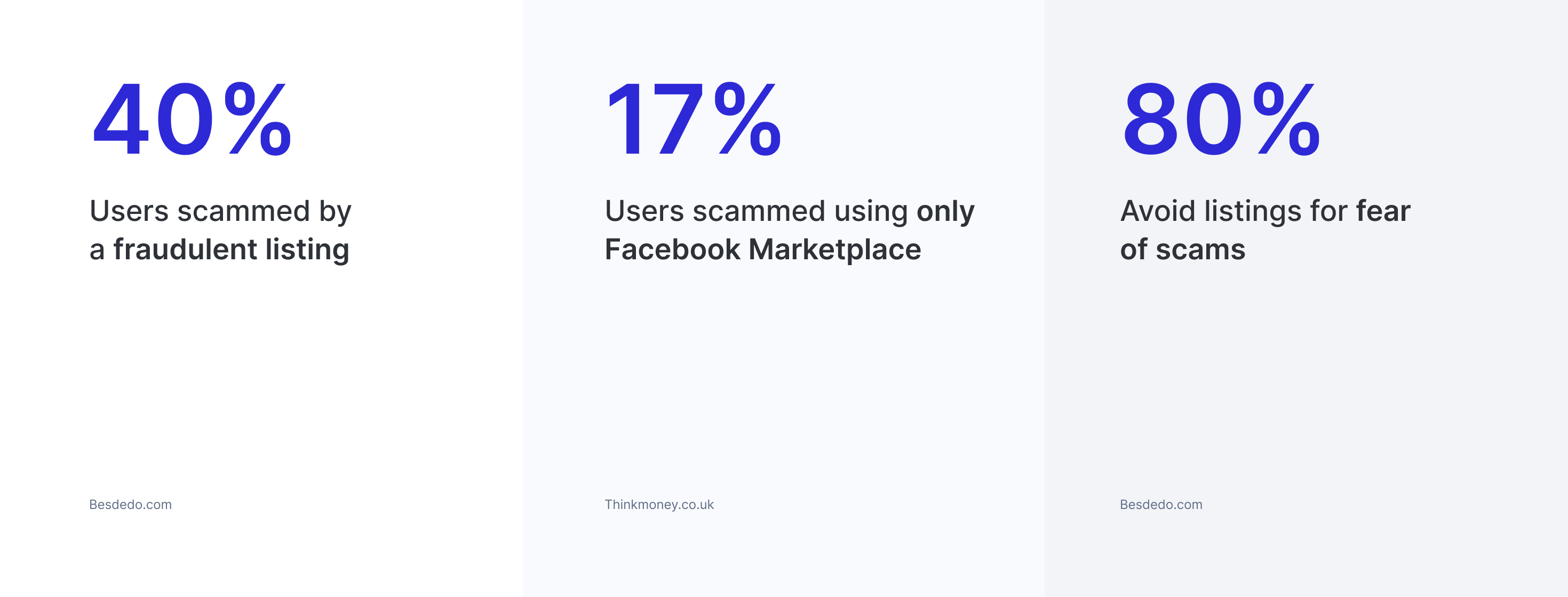
- 40% of users have been scammed by a fraudulent listing.
- Nearly 30% of people who reported losing money to a scam in 2025 said it started on social media, with reported losses reaching $2.1 billion, according to the FTC.
- 80% of users will avoid a listing for fear of being scammed.
Marketplaces need to make it as frictionless as possible for people to become sellers, expanding the universe of companies from 1,000s to millions to potentially billions.
In a world where everyone is a seller, how well do you know your seller (KYS)?
What you will learn in this guide
- Seller fraud is growing faster than seller-side detection. As buyer-side fraud tools have improved, marketplaces have not kept pace on the seller side. Fake listings, non-delivery scams, and seller collusion are now overwhelming platforms that were built to scale seller volume, not screen it.
- Full KYB is not the answer for marketplaces. Banks run comprehensive Know Your Business checks. Marketplaces need a lighter, faster version that catches high-risk sellers without adding friction that drives good ones away.
- Passive detection is the foundation. Device fingerprinting, network link analysis, and email and phone history let you sort sellers into fast and slow lanes before they ever complete registration.
- Screening does not stop at onboarding. Every product listing, cash-out, and review is an opportunity to catch high-risk seller behavior that was not visible at signup.
- The INFORM Consumers Act makes seller verification a legal requirement for marketplaces where sellers complete more than 200 transactions or generate over $5,000 in gross revenue in a 12-month period. Getting ahead of this is easier than catching up after an enforcement action.
Not sure where your seller verification program stands? Talk to an expert to find out.
Why seller fraud is growing faster than market fraud detection
Criminals always find the weakest link. As buyer-side fraud detection tools have improved, marketplaces haven’t focussed as much on adding fraud screening for sellers or merchants.
The second reason is the aperture of possible sellers widens with each possible year. As it gets easier to become a seller, it also becomes easier to list products on a marketplace.
Anatomy of seller fraud
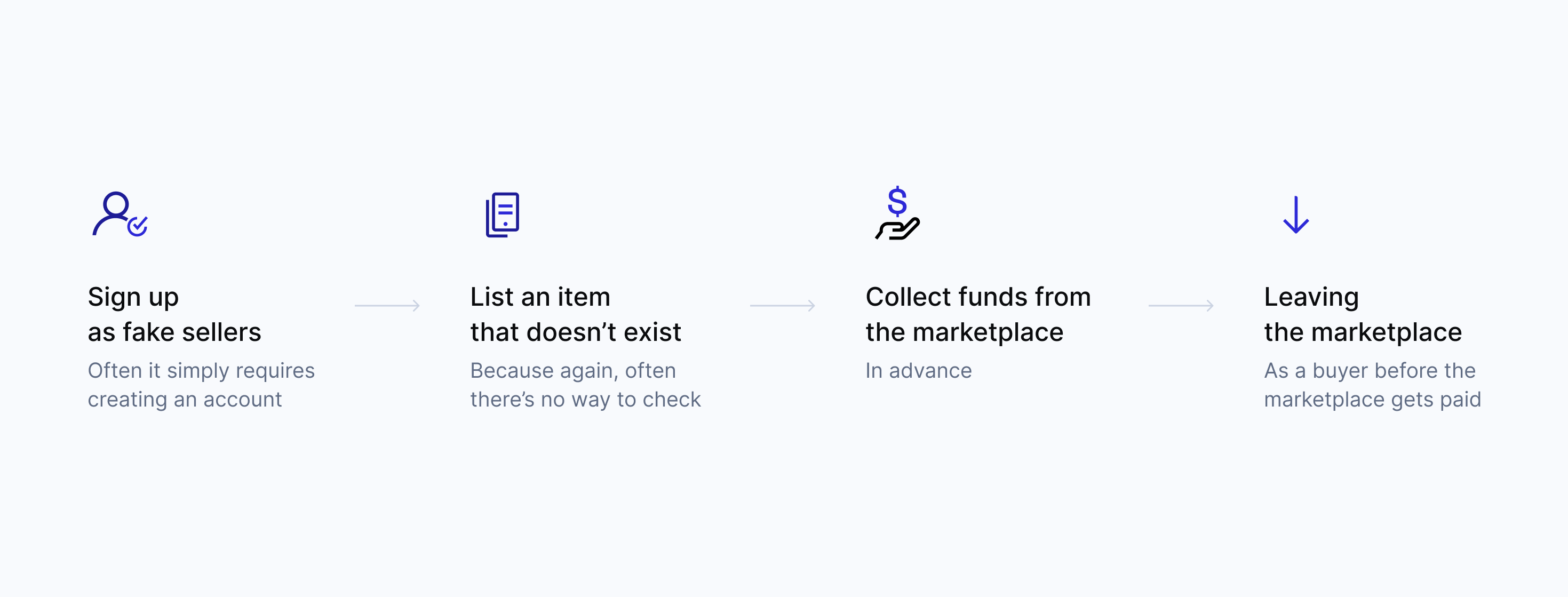
Bad actors
- Sign up as fake sellers because the checks are relatively lightweight (often it simply requires creating an account)
- List an item that doesn’t exist (because again, often there’s no way to check)
- Collect funds from the marketplace in advance
- Leaving the marketplace as a buyer before the marketplace gets paid
There are 100s of nuanced attacks that can be done with seller fraud (see our Tackling marketplace fraud blog for more here). Simple non delivery, new account fraud, fake listings and fake reviews are beginning to overwhelm marketplaces. They’re now dealing with unhappy buyers, and a reputational risk.
The need for lightweight business verification without full KYB
Banks and Fintech companies solve a lot of risk with “KYB” or “Know Your Business” checks. This involves getting detailed identity information about business owners, checking incorporation documents, and even looking into the company's background and operations to verify if they’re a real company.
I know what you’re thinking.
Marketplaces don’t want to be banks.
But they do need to fix their seller problem.
They don’t want to do KYC.
The answer is lightweight “business verification” of the seller. A bank might add more comprehensive checks like EIN verification or verifying documents from the Secretary of State where a business is registered and call this KYB or “Know Your Business.”
Seller identity verification, without adding friction
In principle, we want to only bring businesses through high-friction KYB-style processes if we have some evidence they may be high-risk. For a new seller this can be hard to track but it is entirely possible with passive detection and building a fast lane vs slow lane.
Passive detection means looking for data signals about a potential user without requiring them to input any new information (other than would be required in a standard registration).
We always try to build a fast lane for good potential customers (sellers) and a slow lane for bad potential customers (again, sellers in this case). If the passive detection signals tell us this is a high-risk user, we can drop them into the slow lane and ask for additional information borrowing from the KYB experience.
How seller verification checks work in practice at onboarding
As a working example, let's assume a new seller is registering and could be high-risk; this is how it might play out.
Passive detection techniques help us figure out which lane this user belongs to.
- Device fingerprinting and network link analysis help detect if the same seller is behind multiple seller and buyer personas. For example if the user has shared devices, IPs, or emails we can see this as high risk.
- Email and phone history help in understanding if the email and phone number are new and if they’re registered to the entity they claim to be signing up for.
If we see any red flags ⛳ we can drop them in the slow lane and do further checks like.
- The “True Industry” of a seller by pulling their state fillings
- The card or bank account history of a seller by asking them to enter their receiving account information
Once a user is in a slow lane, we can also take that concept further, like placing hold periods on them getting paid. Often bad actors are trying to make money quickly; the more speed bumps we can put in their way, the less likely they are to get away with it.
How seller verification checks work throughout the seller lifecycle
The key to all fraud prevention is to watch the user throughout their lifecycle on your marketplace. Every product listing, cash-out, and review is an opportunity to screen for high-risk sellers.
Passive detection techniques (on the device, for example) can be very helpful for things like fake reviews and collusion. By identifying a cluster of devices and creating reviews for sellers we already believe to be high-risk. Imagine if the same device that had just signed up as a seller also created 10 buyer accounts and started posting reviews exclusively on listings by the new seller.
The use cases are endless.
There is, however, the small challenge of making that data useful.
Zero to one in Know Your Seller (KYS).
Making the data useful is harder than it should be.
Marketplaces often rely on their payment provider for payment fraud detection and a hodgepodge of other tools to create a more complete picture of their customer. The data is split across the PSP, CRM, infosec, and countless other systems.
Ideally, you need one place for those passive detection data providers and your internal data to be combined into a set of logic (rules) and ways for your fraud team to analyze.
At Sardine we found what we built for banks (the KYB, rules engine, dashboard and device intelligence capabilities) are increasingly popular with our marketplace customers.
So if you’re struggling with more seller fraud, higher volumes of fake goods, and collusion, get in touch.
Frequently asked questions about seller verification checks
What is Know Your Seller (KYS) and why do marketplaces need it?
Know Your Seller is the process of verifying seller identity and screening for fraud risk before and after a seller joins a marketplace. Marketplaces need it because seller-side fraud detection has not kept pace with buyer-side improvements, and the gap is showing up in fake listings, non-delivery scams, and collusion. As it gets easier to become a seller, it also gets easier for bad actors to list products, collect funds, and exit before the marketplace can act.
What is the difference between KYS and KYB for marketplaces?
KYB, or Know Your Business, is the comprehensive verification model used by banks and financial institutions. It involves incorporation documents, EIN verification, Secretary of State filings, and detailed background checks. KYS is a lighter version designed for the marketplace context, where onboarding friction directly affects seller acquisition. The goal is to catch high-risk sellers through passive detection signals rather than requiring every seller to go through a full KYB process.
How does passive detection work for seller verification checks?
Rather than asking every seller for additional information upfront, passive detection reads signals from what sellers already submit during registration. A shared device across multiple accounts, a recently created email address, or an IP linked to known fraud activity can all surface risk before a seller ever lists a product. High-risk signals trigger a slower lane with additional checks. Clean signals get a fast lane with minimal friction.
How does seller fraud detection work beyond onboarding?
A seller who passes onboarding checks can still turn risky over time. Every product listing, cash-out, and review is a new data point. Device data showing a cluster of buyer accounts posting reviews only on one new seller's listings is a classic collusion pattern. Monitoring the full seller lifecycle rather than treating onboarding as a one-time gate is what separates programs that catch fraud early from those that discover it after funds have already moved.
How do payout holds help reduce seller fraud?
Most fraudulent sellers are optimizing for speed. They want to list, collect, and exit before the platform catches up. Holding payouts for sellers who show elevated risk signals removes that speed advantage. It does not block legitimate sellers permanently but it makes the economics of fraud worse, which is often enough to push bad actors toward easier targets.